
Your 2026 Home Doesn’t Need Alexa — Meet the Resident AI
For a decade, the defining sound of the "smart home" was a woman's voice replying from a plastic puck on the kitchen counter. "I'm sorry, I didn't catch that." It was never really intelligence. It was a glorified remote control with a microphone, shipping every syllable you uttered to a data center somewhere in Virginia.
That era is ending — quietly, and from inside the house.
The most sophisticated homes being built in 2026 don't have an Echo on the counter, a Nest Hub on the nightstand, or a HomePod on the shelf. They have a resident AI: a local large language model running on an unobtrusive mini PC in a utility closet, stitched into every sensor, light, and lock in the house. It's always listening, but nothing it hears ever leaves the building.
What Changed
Three things converged in the last eighteen months to make the cloud voice assistant obsolete.
Models got small. Meta's Llama 3.2, Mistral, and a wave of purpose-built home-automation derivatives now run comfortably on 8–16 GB of VRAM. A $600 mini PC with a modest GPU — something the size of a hardcover book — can hold a conversation that would have required a warehouse of servers in 2020.
Home Assistant grew up. The open-source hub has quietly become the most capable smart home platform on the planet, and its Voice Assistant pipeline now lets you wire a local LLM directly into device control. Ask it to "dim the living room to a dinner-party level" and it actually understands what that means in context.
Matter finally shipped. With nearly every major manufacturer now exposing devices over Matter, the old vendor-locked ecosystems are collapsing into a single, protocol-level standard. Your resident AI can talk to a Lutron switch and a Nanoleaf strip with the same API call.
Why Homeowners Are Making the Switch
The pitch isn't "privacy" — although that's real. The pitch is intelligence. A local model trained on your home's context can do things Alexa never could.
- It remembers. "Do what we did last Thursday when the Hendersons came over" is a sentence your resident AI can actually resolve.
- It reasons. "It's going to be cold tomorrow morning — pre-warm the bedroom but not the guest room" becomes a one-shot command instead of a fifteen-step automation.
- It waits. A good resident AI doesn't chirp a wake word at you. It knows when you've walked into a room, who you are, and whether you're likely to want anything.
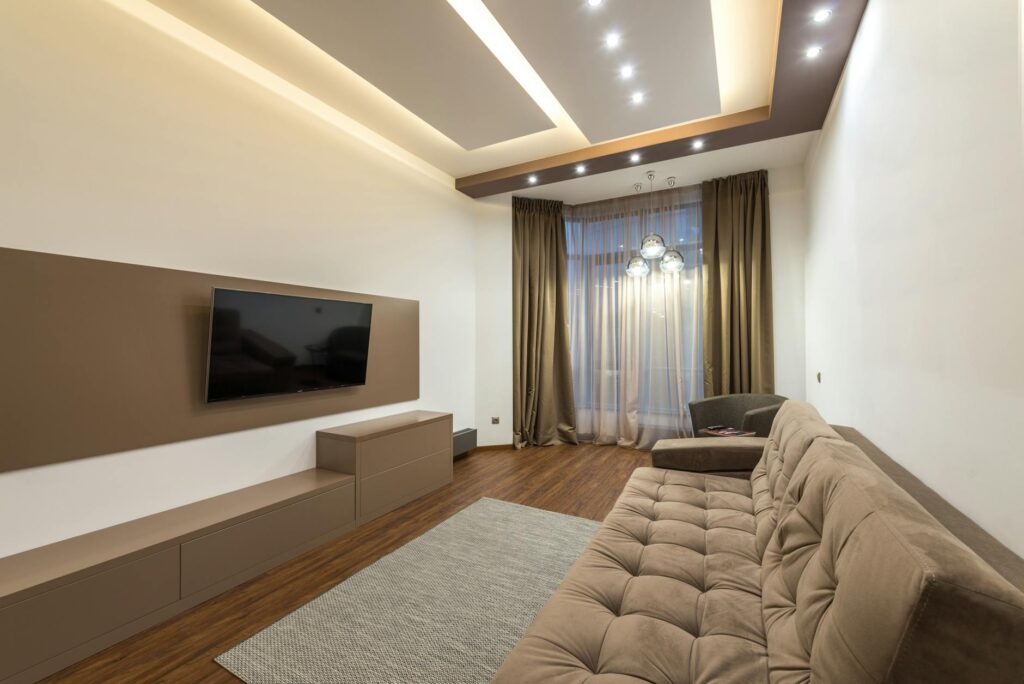
The second benefit — the one the Architectural Digest reader cares about — is that there's nothing to see. No glowing plastic puck. No camera-on-a-counter. No "Alexa, stop" during a dinner party. The intelligence is architectural: present in the walls, invisible to the room.
The Starter Build
If you're considering the switch, the 2026 entry-level stack looks like this:
| Component | What it does | Typical spend |
|---|---|---|
| Mini PC with GPU (Beelink, Minisforum, or a used Mac mini M2) | Runs the local LLM | $500–900 |
| Home Assistant Yellow or Green | Coordinates devices, hosts the Voice Assistant pipeline | $150–250 |
| Ollama or LM Studio | Serves the local model to Home Assistant | Free |
| Small-footprint Matter hub (if needed) | Bridges Thread/Zigbee devices into HA | $60–100 |
| Whole-home microphones (ESP32-based, ceiling-flush) | Replaces counter-top smart speakers | $15–30 each |
The whole system fits in a single cabinet shelf. Nothing is visible from any room in the house.
What It Still Can't Do
Let's be honest: a resident AI in April 2026 is not as fluent as GPT-5 or Claude Opus 4.6. Latency is higher. Some multi-step reasoning still stumbles. And you are now the IT department for your own house — when something breaks at 11pm, there is no Amazon support line to call.
For most early adopters, that tradeoff is trivial. The home feels like yours again, not like a kiosk leased from a trillion-dollar ad company.
The Architect's Takeaway
The smart home of 2020 asked you to decorate around its hardware. The smart home of 2026 disappears into the hardware you already chose — the credenza, the cabinet, the closet — and listens only to the room it serves. If you've been holding off on "going smart" because the aesthetics were always off, this is the generation that finally earns the upgrade.
Starting smaller? Our guide to 5 High-Design Smart Lighting Upgrades Under $100 is a good on-ramp to the invisible-tech philosophy before you commit to a full local AI stack.


